
Designed by Paul Smith 2006. This website is copyrighted by law.
Material contained herewith may not be used without the prior written permission of FAUNA Paraguay.
Photographs on this web-site were taken by Paul Smith, Hemme Batjes, Regis Nossent, Frank Fragano,
Alberto Esquivel, Arne Lesterhuis, José Luis Cartes, Rebecca Zarza and Hugo del Castillo and are used with their permission.
Lophostoma brasiliense W. Peters, 1867
TAX: Class Mammalia; Subclass Theria; Infraclass Metatheria; Order Chiroptera; Suborder Microchiroptera; Superfamily Noctilionoidea; Family Phyllostomidae, Subfamily Phyllostominae (López-Gonzalez 2005, Myers et al 2006). There are six species in the genus Lophostoma, d´Orbigny 1836, two of which are present in Paraguay. The origin of the generic name Lophostoma is Greek meaning "crest mouth" possibly in reference to the row of bony tubercles present on the lower lip. The species name brasiliense refers to the origin of the type specimen as Brazil. The date of description is often cited as 1866, but the pages on which the species was described were actually published in 1867 (Gardner 2007). The species is monotypic. The type specimen is an adult female deposited in the British Museum of Natural History (BMNH 49.11.7.14) with type locality Bahía, Brazil. This species was formerly considered to belong to the genus Tonatia (Gray 1827) but numerous authors had noted that some of the species included were highly divergent from others. Lee et al (2002) performed a revision and molecular review of the phylogenetics of the genus and concluded that it should be split into two distinct genera, with the majority of species, including this one relocated in Lophostoma. The genus Lophostoma is neuter and necessitates the species name ending brasiliense. If returned to Tonatia (feminine) the species name should be altered to brasiliensis. Synonyms adapted from Gardner (2007):
Lophostoma brasiliense W.Peters 1867:674. Type locality "Baía" (=Salvador), Bahía.
Lophostoma venezuelae W. Robinson & Lyon 1901:154. Type locality "Macuto, Venezuela".
[Tonatia] brasiliense Trouessart 1904:111. Name combination.
[Tonatia]venezuelae Miller 1907:129. Name combination.
Tonatia nicaraguae Goodwin 1942:205 Type locality "Kanawa Creek, near Cukra, north of Bluefields, Nicaragua".
Tonatia minuta Goodwin 1942:209 Type locality "Boca Curaray, Ecuador" (=Boca del Río Curaray, Loreto, Peru).
Tonatia brasiliensis Handley 1976:16 Name correction and correct gender.
[Lophostoma ]brasiliense Lee, Hoofer and Van den Bussche 2002:55 First modern use of current name combination.
ENG: Pygmy Round-eared Bat (Gardner 2007), Lesser Round-eared Bat (Goodwin 1961), Little Round-eared Bat (Goodwin 1961).
ESP: Murciélago de orejas redondas enano.
GUA: No known names.
DES: The smallest of the Paraguayan Lophostoma/Tonatia group with long, rounded ears and a short tail. Pelage long and smooth, but not dense, warm brown in colour (Prout´s brown - Goodwin 1942), but becoming somewhat darker around the face (Mummy brown - Goodwin 1942) and with a creamy base to the fur. Venter slightly paler than dorsum and with pale buffy wash. Muzzle sparsely-furred, appearing almost naked and rows of small rounded tubercles on the chin forming a U-shape. Eyes small. Nose leaf large and prominent, lanceolate in shape and relatively broad. Ears large with rounded tips, with hair on the upper edge and connected by a band of skin across the forehead, colour blackish with pinkish bases. Thumb furred and second phalanx with a longer claw than the first. Uropatagium longer than the legs, and short tail (approximately half the uropatagial length) is completely enclosed within it, except for the tip which protrudes slightly from the dorsal side. Wing and tail membranes blackish. Feet robust. Measurements important for specific identification. (Goodwin 1942, Goodwin 1961, Emmons 1999).
CR - Skull with short, broad rostrum that rises abruptly towards the brain case. Brain case rounded with a narrow sagittal crest and interorbital constriction. Palate short. (Goodwin 1942, López-González 2005). Measurements taken from the only Paraguayan specimen (a female) from López-González (2005): Greatest Skull Length 20.3mm; Condylobasal Length 18.3mm; Transverse Zygomatic Width 9.8mm; Mastoid Width 9.7mm; Interorbital Constriction 3.4mm; Width Across Upper Molars 6.9mm; Width Across Upper Canines 4.2mm. DF: I2/1 C 1/1 P2/3 M3/3 = 32. One pair of lower incisors only. Measurements taken from the only Paraguayan specimen (a female) from López-González (2005): Upper Tooth Row 7.2mm; Lower Tooth Row 7.9mm. CN: 2n=30. FN=56. (Redford & Eisenberg 1992).
MMT: Measurements taken from the only Paraguayan specimen (a female) from López-González (2005): TL 61mm; TA 8mm; FT 9mm; FA 40.2mm; EA 24mm; Length of Third Digit 34.3mm; WT 13.8g. Additional measurements provided by Eisenberg (1989) for specimens from Venezuela: TL male 63.25mm (+/-2.31), female 60.60mm (+/-3.21); HB male 52.38mm (+/-3.16), female 51mm (+/-4.18); TA male 10.88mm (+/-2.59), female 9.60mm (+/-3.36); FT male 11.88mm (+/-0.83), female 11.80mm (+/-0.84); FA male 34.63mm (+/-0.91), female 35.34mm (+/-1.69); EA male 24.75mm (+/-1.91), female 24.40mm (+/-0.89); WT male 9.94g (+/-0.53), female 10.75g.
SSP: This is a small Phyllostominae (long ears, nose leaf well-developed with horseshoe shape enclosing the nostrils) with a short tail and round-tipped ears. Bats in the genus Lophostoma are extremely similar to Tonatia bidens and can be most easily separated on account of the naked or sparsely-furred muzzle and the fact that they roll their ears when handled. Both Tonatia and Lophostoma are unique amongst small Phyllostomids in having only one pair of lower incisors, the character being shared only by the much larger Chrotopterus auritus. This species can be distinguished from the other Paraguayan member of the genus L.sylvicolum principally by its smaller size, having a forearm <45mm as opposed to >50mm, being about half the weight (silvicolum generally not less than 25g, brasiliense usually not more than 15g). and with an ear length that is invariably <27mm in brasiliense compared to >30mm in silvicolum. Note also that L.silvicolum frequently has a white throat patch of variable size which is not present in this species. The tragus of this species is comparatively much smaller than that of L.silvicolum and lacks the three tooth-like projections near the base on the outer edge, instead having a single, pointed toot-like projection near the base on the inner border (Genoways & Williams 1980). T.bidens possesses a more or less conspicuous median white stripe on the head that helps identify. The only other member of the subfamily that even appoaches this species in size is the Long-legged Bat Macrophyllum macrophyllum, but that species can be easily separated on account of its over-sized feet, long tail and longitudinal rows of dermal denticles on the ventral side of the uropatagium.
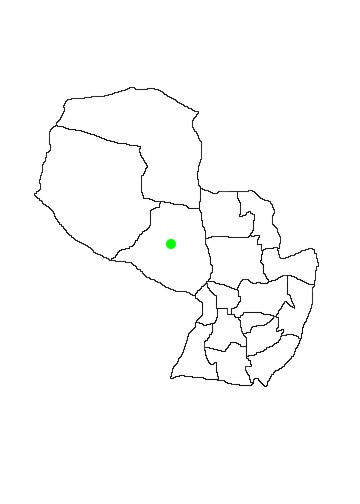
DIS: Widespread occurring from southern Veracruz in Mexico south through Central America to South America east of the Andes. In Brazil occurs south coastally to Rio de Janeiro, but inland the southern limits of the range are much further north. Known only from a single record at a single locality in Paraguay which extended the species known inland range south by over 1000km (López-González et al 1998). A female was taken at Estancia La Victoria, Departamento Presidente Hayes (23o 29.04’S, 58o 34.79’W) on 29 July 1995 about 50m from the Rio Siete Puntas.
HAB: The only Paraguayan specimen was caught 50m from a river in a mist-net placed at 4.5m high in palm savanna dominated by the palm Copernicia australis. (López-González et al 1998). Elsewhere the species is strongly associated with moist areas and streamside habitats and can range into deciduous forest (Eisenberg & Redfor 1999) or more open secondary vegetation and savannah forest (Genoways & Williams 1984). Of 51 specimens captured in Venezuela 34% were captured over or near streams, 48% in moist areas and just 18% in dry situations (Handley 1976).
ALI: Diet probably consists of fruit and insects (Gardner 1977). Members of this genus are perch hunters that detect prey by emitting sounds whilst hanging from a branch and flying out to capture it once it is located (Emmons 1999).
REP: Pregnant females were taken in Costa Rica in February and April, and in Brazil a female pregnant with a 34mm long foetus was taken on 22 August (Graciolli & Bernard 2002). A pregnant female with a 13mm long foetus was taken in Surinam on 13 September 1979 (Genoways & Williams 1984).
BEH: General The species is usually caught in mist nests shortly after dusk. In Trinidad the species has been found roosting in termite nests (Goodwin & Greenhall 1961) and Emmons (1999) suggested that the ability to fold the ears may be an adaptation to such specialised roost sites. Parasites Presley (2005) found 12 parasites on 1 specimen of this bat in Paraguay it having a monoxenous association with a spinturnicid (Mastoptera minuta) and a single Parichoronyssus sclerus. Herrin & Tipton (1975) reported the spinturnicid mite Periglischrus tonatii from Venezuela.
VOC: No information.
HUM: None. The species has only recently been confirmed as present in Paraguay and the only record is from an area with low human population.
CON: Globally considered to be of Low Risk Least Concern by the IUCN, click here to see the latest assessment of the species on account of its wide geographic range and unspecialised habitat requirements. Considered stable in Paraguay by López-Gonzalez (2005) though the species is currently known from a single specimen in an unprotected area. As far is as currently known the Paraguay record represents the southern limits of the species range and the scarcity of specimens suggests that it is at best uncommon. The species might best be considered Data Deficient in Paraguay.
Citable Reference: Smith P (2008) FAUNA Paraguay Online Handbook of Paraguayan Fauna Mammal Species Account 28 Lophostoma brasiliense.
Last Updated: 22 January 2009.
References:
d´Orbigny 1836 - Voyage dans l´Amérique Méridionale (le Brésil, la République Orientale de l´Uruguay, la République Argentine, la Patagonie, la République du Chili, la République de Bolivia, la République de Pérou) Exécuté Pendants les Années 1826-1833 - P. Bertrand, Paris.
Eisenberg JF, Redford KH 1999 - Mammals of the Neotropics: Volume 3 The Central Neotropics - University of Chicago Press, Chicago.
Eisenberg JF 1989 - Mammals of the Neotropics: Volume 1 The Northern Neotropics - University of Chicago Press, Chicago.
Emmons LH 1999 - Mamíferos de los Bosques Húmedos de América Tropical - Editorial FAN, Santa Cruz.
Gardner 1977 - Feeding Habits p293-350 in Baker RJ, Jones JK, Carter DC, Biology of Bats of the New World Family Phyllostomidae Part 2 - Texas Tech Museum Special Publications 13.
Gardner AL 2007 - Mammals of South America Vol 1: Marsupials, Xenarthrans, Bats and Shrews - University of Chicago Press, Chicago.
Genoways HH, Williams SL 1980 - Results of the Alcoa Foundation-Suriname Expeditions I: A New Species of Bat of the Genus Tonatia (Mammalia: Phyllostomidae) - Annals of the Carnegie Museum 49: p203-211.
Genoways HH, Williams SL 1984 - Results of the Alcoa Foundation-Suriname Expeditions IX: Bats of the Genus Tonatia (Mammalia: Chiroptera) in Suriname - Annals of the Carnegie Museum 53: p327-346.
Goodwin GG 1942 - A Summary of Recognisable Species of Tonatia with Descriptions of Two New Species - Journal of Mammalogy 23: p204-209.
Goodwin GG, Greenhall AM 1961 - A Review of the Bats of Trinidad and Tobago - Bulletin AMNH 122: p187-302.
Graciolli G, Bernard E 2002 - Novos Registros de Moscas Ectoparasitas (Diptera, Streblidae e Nycteribidae) em Morcegos (Mammalia: Chiroptera) no Cerrado de Brasília, Distrito Federal, Brasil - Revista Brasileira de Zoologia 19 (supp): p77-86.
Gray JE 1827 - The Animal Kingdom Arranged in Conformity with its Organisation by the Baron Cuvier with Additional Descriptions of all the Species Hitherto Named and of Many Not Before Noticed by Edward Griffith....and Others - E.Griffith, London.
Handley CO 1976 - Mammals of the Smithsonian Venezuelan Project - Brigham Young Univ. Sci. Bull. Biological Series 20: p1-89. LARGE FILE!
Herrin CS, Tipton VJ 1975 - Spinturnicid Mites of Venezuela (Acarina: Spinturnicidae) - Brigham Young Univ. Sci. Bull. Biological Series 20: p1-72. LARGE FILE!
Lee TE, Hoofer SR, Van den Bussche RA 2002 - Molecular Phylogenetics and Taxonomic Revision of the Genus Tonatia (Chiroptera: Phyllostomidae) - Journal of Mammalogy 83: p49-57.
López-Gonzalez C, Presley SJ, Owen RD, Willig MR, Gamarra de Fox I 1998 - Noteworthy Records of Bats (Chiroptera) from Paraguay - Mastozoologia Neotropical 5: p41-45.
López-Gonzalez C 2005 - Murciélagos del Paraguay - Biosfera Numero 9.
Miller GS 1907 - The Families and Genera of Bats - Bulletin US National Museum 57.
Myers P, Espinosa R, Parr CS, Jones T, Hammond GS, Dewey A 2006 - The Animal Diversity Web (online). Accessed December 2007.
Novak RM 1991 - Walker´s Mammals of the World 5th Ed Volume 1 - Johns Hopkins, Baltimore.
Peters W 1867 - Fernere Mittheilungen zur Kenntniss der Flederthiere Namentlich über Arten des Leidener und Britischen Museums - Monatsber. König. Preuss. Akad. Wiss. Berlin 1867: p672-681.
Presley SJ 2005 - Ectoparasitic assemblages of Paraguayan bats: ecological and evolutionary perspectives - Texas Tech University PhD Dissertation.
Robinson W, Lyon MW 1901 - An Annotated List of Mammals Collected in the Vicinity of La Guaira, Venezuela - Proceedings US National Museum 24: p135-162.
Trouessart EL 1904 - Catalogus Mammalium tam Viventium quam Fossilium. Quinquennale Supplementium Anno 1904 - Friedlander & Sohn, Berolini.
MAP 28:
Lophostoma brasiliense